
Publishing blog posts regularly doesn’t automatically make a website authoritative. Many businesses have dozens of articles but still struggle to attract consistent organic traffic because those articles were created around individual keywords rather than a clear topic.
The problem is often structure and depth, not content volume.
Topical authority comes from building a website that covers a subject thoroughly and connects related pieces of content in a logical way. Instead of treating your blog as a collection of standalone articles, think of it as a connected knowledge base that helps readers find answers at different stages of their search.
In this guide, we’ll show you how to choose a core topic, map related subjects, build content clusters, create useful internal links, demonstrate expertise, and measure the progress of your strategy.
Want to Build a More Effective Content Strategy?
Your content should do more than fill your blog. We can help you build a structured content strategy that supports organic visibility and long-term business growth.
What Is Topical Authority?
Topical authority is the depth and breadth of useful content a website has around a particular subject. A website develops it by consistently covering related topics and answering the questions its audience is likely to have.
It’s different from ranking one article for one keyword.
A keyword-focused approach asks:
“Can I rank this article?”
A topic-focused approach asks:
“Can my website become a useful resource on this subject?”
That distinction matters. One article might rank well for a specific search term, but that doesn’t necessarily mean the rest of the website demonstrates meaningful coverage of the subject.
A stronger approach is to build a group of related pages. A broad pillar page can cover the main subject, while supporting articles answer narrower questions. Internal links then connect those pages so both readers and search engines can understand how the content relates.
Think of it this way:
Random blog posts → disconnected pages
versus:
Core topic → related subtopics → connected content
The second structure gives your website a much clearer purpose and makes it easier to build depth around the subjects that matter to your business.
Why Topical Authority Matters for SEO
Topical authority isn’t about publishing as many articles as possible. It’s about building useful coverage around subjects that are genuinely relevant to your business and audience.
It helps search engines understand how your pages relate to one another, creates more opportunities to rank for related searches, and makes your site easier for readers to navigate.
A well-structured cluster also gives you more useful internal linking opportunities. A broad guide can point readers to detailed resources, while those supporting pages can link back to the broader guide or to other relevant content.
Most importantly, it turns your website into a resource rather than a collection of disconnected posts.
Start With a Core Topic Your Business Wants to Own
The first step in building topical authority is choosing the right subject to focus on. Your core topic should sit at the intersection of what your business offers, what your audience needs, and what you have enough expertise to cover well.
Consider:
- Products or services: What do you actually sell?
- Customer problems: What problems does your business solve?
- Industry expertise: What subjects can you discuss with confidence?
- Business goals: Which topics can attract the customers you want?
- Existing authority: What subjects does your website already cover?
- Search demand: Are people actively searching for information about the topic?
Don’t choose a topic simply because it has high search volume. A large audience won’t help much if the subject has little connection to your business.
For example, a marketing agency might choose content marketing as a core topic and build coverage around:
- Content strategy
- SEO content
- Content planning
- Content creation
- Content optimization
- Content distribution
- Content measurement
The goal isn’t to cover everything on the internet. It’s to become a useful resource within a subject that matters to your business.
Map the Subtopics Within Your Core Topic
Once you’ve chosen a core topic, break it into the subjects your audience needs to understand.
Start with the main topic, then identify its subtopics, common questions, related concepts, and the different stages of the buyer journey. This gives you a content map before you start publishing.
For example, content marketing could branch into content strategy, content creation, SEO, distribution, measurement, and content audits. Each of those areas can then be broken down further.
Think in Topics, Not Just Keywords
One of the easiest ways to create a messy blog is to treat every keyword variation as a separate article.
That can lead to repetitive content, keyword cannibalization, thin pages, and a site structure that makes little sense to readers.
Instead, group related searches by meaning and search intent.
If several keywords are asking essentially the same question, they may belong on one comprehensive page. If they represent different questions or intents, separate articles may make more sense.
The goal is not to create the most pages. It’s to create the right pages.
Identify Content Gaps
Your content map should also show you what’s missing.
Look at:
- Questions customers regularly ask
- Topics your existing content doesn’t cover
- Competitor content that fills gaps on your site
- Related questions appearing in search results
- Important subtopics that deserve deeper coverage
A content gap isn’t simply a keyword your competitor ranks for. It’s a useful topic your audience needs that your website hasn’t adequately addressed.
Build Pillar Pages and Supporting Content
Now turn your topic map into an organized content structure.
A pillar page covers a broad subject and provides an overview of the key areas within it. Supporting articles then go deeper into specific questions or subtopics.
This creates a content cluster where each page has a clear role.
What Is a Pillar Page?
A pillar page is a comprehensive resource covering a broad topic.
It should:
- Explain the main subject clearly
- Cover the major subtopics
- Link to more detailed resources
- Help readers understand where to go next
The pillar shouldn’t try to answer every question in exhaustive detail. Its job is to provide a strong overview and connect readers to deeper content.
What Are Supporting Articles?
Supporting articles focus on narrower subjects within the main topic.
They might answer a specific question, solve a particular problem, or target a different search intent.
For a content marketing cluster, supporting articles could cover:
- How to create a content strategy
- How to conduct a content audit
- How to measure content marketing ROI
- How to distribute content effectively
- How to optimize existing content
Where appropriate, these pages should link back to the pillar page and to other relevant supporting content.
How the Pieces Work Together
Think of the structure like the image below:
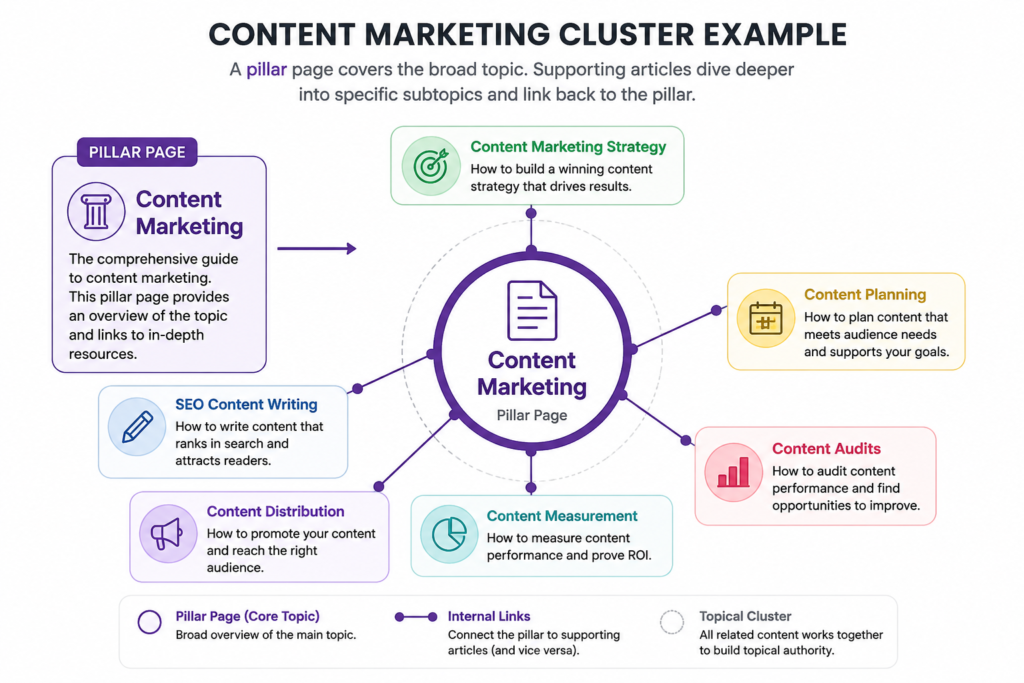
The important part isn’t simply having these pages. It’s connecting them.
A reader researching content marketing should be able to move from the broad subject to a specific question without having to start another search. That interconnected structure also gives search engines clearer context about the relationship between your pages.
Create Content That Covers Search Intent, Not Just Keywords
Keywords tell you what people search for. Search intent tells you what they actually want.
That distinction matters when building topical authority. A strong content strategy should cover the different reasons people search for information within a topic, rather than creating multiple articles around minor keyword variations.
The main types of search intent include:
- Informational: The person wants to learn something.
- Commercial investigation: They’re comparing options before making a decision.
- Transactional: They’re ready to take an action, such as buying a product or hiring a service.
- Navigational: They’re looking for a specific website, brand, or page.
One topic can require content for several of these intents.
For example, an SEO content cluster could include:
- What Is SEO? → informational
- SEO vs. PPC → commercial investigation
- How to Create an SEO Strategy → informational/how-to
- Best SEO Agencies → commercial investigation
- SEO Services → transactional
Each page serves a different purpose, but together they provide broader coverage of the topic.
The goal is complete topic coverage, not keyword stuffing.
Strengthen Your Content With Expertise and Original Value
Covering a topic thoroughly isn’t enough if every article simply repeats what other websites have already said.
Your content needs something of its own.
That could come from:
- First-hand experience
- Original examples
- Case studies
- Data and research
- Expert commentary
- Screenshots
- Original processes or frameworks
- Lessons learned from real projects
For example, instead of explaining content audits entirely from theory, a marketing agency could show how it approaches an audit, what it looks for, and what changes typically make the biggest difference.
Google’s guidance on creating helpful, reliable, people-first content emphasizes original information, substantial coverage, expertise, and creating content primarily to help people rather than manipulate search rankings.
And don’t confuse depth with length.
A 1,500-word article that completely answers a reader’s question can be more useful than a 4,000-word article padded with repetition. Write until you’ve covered the subject properly, then stop.
Build a Strong Internal Linking Structure
Internal links are what turn individual articles into a connected content system.
They help readers discover related information and give search engines additional context about the relationships between your pages.
Link From Pillar Pages to Supporting Content
As shown in our diagram above, when a pillar page introduces a subtopic, link to a more detailed article that covers it.
For example, a broad content marketing guide might link to a detailed guide on content audits when discussing content optimization.
Link Supporting Content Back to the Pillar
The relationship should work both ways.
A supporting article can link back to the broader pillar page when readers may need more context or want to explore the wider subject.
Connect Related Supporting Articles
Don’t limit your internal linking to pillar-to-supporting-page links.
If two supporting articles genuinely relate to each other, connect them. This makes the content easier to navigate and creates a more logical structure across the site.
Use Descriptive Anchor Text
When adding internal links, make the anchor text specific enough to tell readers what they’ll find when they click. Avoid vague phrases such as “click here” or “read more.”
For example, instead of writing:
Click here to learn more about content strategy.
You could write:
Learn more about how to build a content strategy.
The second version gives readers context before they click and makes the relationship between the two pages clearer.
Use Digital PR to Strengthen Your Authority
Publishing useful content builds expertise on your own website. Digital PR helps that expertise get noticed elsewhere.
Relevant media coverage, industry mentions, and quality backlinks can expand your visibility beyond search results and send referral traffic back to your site.
Digital PR also gives you opportunities to put original research, expert insights, and useful content in front of audiences that may never have discovered your website through organic search.
It shouldn’t replace content marketing. The two work better together: content gives people something worth referencing, while Digital PR helps more people discover it.
For a deeper look at how this works, read What Is Digital PR and Why Does Your Business Need It?
Keep Your Content Fresh and Fill the Gaps
Topical authority isn’t a one-time project. A content cluster can become outdated, develop gaps, or lose relevance as your industry and audience change.
Review your existing content regularly and look for opportunities to:
- Update outdated information.
- Add missing sections or questions.
- Improve pages that aren’t performing well.
- Find questions your existing content hasn’t answered.
- Create new supporting articles where the cluster needs more depth.
- Merge overlapping articles that target the same intent.
- Add relevant internal links as the content cluster grows.
This is particularly important for businesses with an established blog. You may already have most of the content you need; the bigger opportunity could be improving what you’ve already published.
How to Measure Topical Authority
There isn’t a single Google metric called “topical authority” that tells you how authoritative your website is on a subject.
Instead, look at several signals together:
- Organic impressions
- Organic clicks
- Rankings across related queries
- Number of pages receiving organic traffic
- Growth in non-branded search traffic
- Performance of the overall content cluster
- Internal linking coverage
- Organic leads and conversions
Google Search Console is particularly useful for monitoring impressions, clicks, and the search queries bringing people to your pages.
Look at the Cluster, Not Just One Article
Don’t judge your strategy by the performance of a single page.
One article might rank poorly while the other pages in the same cluster are gaining impressions and attracting traffic. Another page might generate little traffic but still support stronger pages through internal links.
Look at the performance of the topic as a whole.
If more related pages are gaining visibility, your cluster is attracting traffic from a wider range of searches, and organic leads are increasing, you’re moving in the right direction.
Common Topical Authority Mistakes
A few mistakes can weaken an otherwise solid strategy:
- Publishing random topics: Every article should have a clear role within your broader content strategy.
- Chasing every keyword variation: Related searches with the same intent often belong on one strong page.
- Prioritizing quantity: Five useful articles can be more valuable than 20 weak ones.
- Ignoring search intent: Targeting a keyword isn’t enough if the page doesn’t satisfy what the searcher wants.
- Skipping internal links: Useful pages become isolated when nothing connects them.
- Writing for search engines: Write for people first. Search visibility should follow useful content.
- Never updating content: Review important pages as information, competitors, and search intent change.
- Covering irrelevant topics: High search volume means little if the subject has no meaningful connection to your business.
Topical authority should reinforce what you want your business to be known for.
A Simple Topical Authority Framework
You don’t need a complicated process to start. Use this nine-step framework:
1. Choose your core topic
Focus on a subject that’s relevant to your business and customers.
2. Map related subtopics
Identify the questions, concepts, and problems surrounding that topic.
3. Group keywords by intent
Decide which searches belong together and which deserve separate pages.
4. Create pillar and supporting content
Build broad resources alongside focused articles that cover specific areas.
5. Connect the content with internal links
Help readers and search engines understand how your pages relate.
6. Add original expertise
Use your experience, examples, research, data, and unique insights to make the content more useful.
7. Strengthen authority with Digital PR
Get valuable content and expertise in front of relevant audiences beyond your own website.
8. Update and expand the cluster
Fill gaps, improve existing pages, merge overlapping content, and add new resources when needed.
9. Measure organic performance
Track the growth of the entire topic rather than judging the strategy by one page.
The important thing is to treat these steps as an ongoing process. Topical authority grows as your website becomes a better, more complete resource on the subjects that matter to your business.
Frequently Asked Questions
What is topical authority in SEO?
Topical authority is the depth and breadth of useful content a website has around a subject. It develops through consistent coverage, relevant answers, and logical connections between pages.
How long does it take to build topical authority?
There is no fixed timeline. It depends on your site’s existing authority, competition, content quality, topic depth, and consistency.
How many articles do I need to build topical authority?
There is no magic number. Cover the important questions and subtopics your audience needs instead of aiming for a fixed number.
What is the difference between topical authority and domain authority?
Topical authority concerns coverage of a subject. Domain Authority is a third-party metric that estimates overall ranking strength. They measure different things, and Domain Authority isn’t a Google ranking factor.
Do topic clusters still matter for SEO?
Yes, when they’re based on genuine relationships between topics and search intent. They help organize related content and improve navigation and internal linking.
Can small businesses build topical authority?
Absolutely. Focus on a smaller number of subjects closely related to your products, services, customers, and expertise.
Conclusion
Don’t build a blog. Build a body of knowledge.
Start with subjects that matter to your business and your customers. Then map the related questions, create useful pillar and supporting content, connect those pages with internal links, and add insights that demonstrate genuine expertise.
As your content library grows, keep improving it. Update outdated pages, fill gaps, remove unnecessary overlap, and measure how the entire topic performs rather than focusing on individual articles.
That’s how content marketing becomes more than a publishing exercise. It becomes a system for building organic visibility, authority, and long-term business growth.
Ready to Build a Content Strategy That Supports Long-Term Growth?
Odafe Media helps businesses plan, structure, and create content that builds organic visibility and authority over time.